

Inversions are often the hallmark of an advanced physical practice, whether in yoga, gymnastics, or calisthenics. While they are frequently viewed as feats of balance and core strength, the true mechanical foundation of a successful inversion lies in the complex orchestration of the shoulder girdle. Specifically, scapular stability is the primary determinant of whether an inversion is sustainable and safe or a recipe for chronic impingement and acute injury. Mastering the biomechanics of the scapula requires an understanding of how the shoulder blade moves, the muscles that govern its position, and the kinetic chain that transfers weight from the hands through the torso.
The Scapulohumeral Rhythm in Inverted Positions
In a standing position with arms at the sides, the scapula rests against the posterior rib cage. However, when we transition into an inversion like a handstand or forearm stand, the relationship between the humerus (upper arm bone) and the scapula must shift dynamically. This is known as scapulohumeral rhythm. In a typical overhead reach, for every two degrees of humeral elevation, the scapula must upwardly rotate by one degree.
In an inversion, this rhythm becomes even more critical because the shoulder is now a weight-bearing joint. Instead of moving through space, the arms are fixed to the floor (closed kinetic chain). This means the scapula must provide a stable platform for the entire weight of the lower body. If the scapula fails to upwardly rotate and protract sufficiently, the head of the humerus can jam into the acromion process, leading to subacromial impingement.
Key Muscle Groups for Scapular Stability
Stability is not synonymous with rigidity. In the context of inversions, stability is the ability of the muscles to maintain the integrity of the joint while resisting the forces of gravity. Several key muscles work in concert to achieve this.
The Serratus Anterior: The Anchor
The serratus anterior is arguably the most important muscle for any athlete seeking to master inversions. Originating on the surface of the upper eight ribs and inserting into the medial border of the scapula, its primary roles are protraction and upward rotation. In a handstand, the serratus anterior “wraps” the shoulder blade around the rib cage, preventing “winging” and creating a wide, stable base. It also helps to depress the chest away from the floor, creating the necessary space in the shoulder joint to avoid compression.
The Trapezius: The Upward Rotators
The trapezius is divided into three functional parts, but the lower and middle fibers are the stars of scapular stability in inversions. While the upper trapezius helps with elevation (shrugging toward the ears), the lower trapezius is essential for pulling the medial border of the scapula down and in. This counter-pull ensures that the shoulder blades do not simply collapse toward the neck, which would result in a loss of balance and restricted breathing.
The Rotator Cuff: Dynamic Centration
While the larger muscles handle the heavy lifting, the four muscles of the rotator cuff (supraspinatus, infraspinatus, teres minor, and subscapularis) perform the fine-tuning. Their job is “centration”—keeping the head of the humerus centered within the shallow glenoid fossa. In an inversion, the rotator cuff prevents the arm bone from sliding out of place as the center of mass shifts.
The Role of Scapular Elevation and Protraction
One of the most common cues in handstand training is to “push the floor away.” Biomechanically, this cue translates to scapular elevation and protraction. When you are right-side up, shrugging your shoulders is generally discouraged in postural training. However, when you are upside down, elevation is a safety mechanism.
By elevating the scapula, you engage the levator scapulae and upper trapezius to create a solid “shelf” for the head and neck. This prevents the “dumping” of weight into the ligamentous structures of the shoulder. Simultaneously, protraction (moving the shoulder blades away from each other) engages the serratus anterior to create a hollow-body shape. This hollow shape is more mechanically efficient for weight distribution than a flat back because it engages the anterior kinetic chain, connecting the shoulders to the core.
Biomechanical Challenges: Avoiding the Banana Back
A failure in scapular stability often manifests as the “banana back” or excessive lumbar arching. When the shoulders lack the range of motion or the strength to stay fully open (180 degrees of flexion), the body compensates by arching the lower back to keep the center of mass over the base of support.
This compensation is dangerous for two reasons. First, it places massive sheer force on the lumbar vertebrae. Second, it shifts the weight-bearing responsibility away from the muscular system and into the passive structures of the spine. To fix a banana back, one must often look not at the spine, but at the scapula. Improving the ability of the scapula to upwardly rotate allows for a “stacked” alignment where the wrists, elbows, shoulders, hips, and ankles form a straight vertical line. This stacking utilizes the skeletal system to bear weight, requiring less muscular effort to maintain the position.
Proprioception and the Closed Kinetic Chain
Inversions turn our world upside down, literally and sensorially. Our vestibular system (the inner ear) and our proprioceptors (sensory receptors in the muscles and joints) must recalibrate. In a standing position, we rely on our feet for feedback. In an inversion, our hands and shoulders become our primary source of sensory input.
Developing scapular stability involves training the brain to recognize where the shoulder blades are in space without the benefit of sight. This is why drills such as “scapular push-ups” or “wall walks” are so effective. They isolate the movement of the scapula while the hands are fixed, forcing the nervous system to refine the motor patterns required for stability under load.
Training Progressions for Stability
Mastering the biomechanics of the shoulder blade does not happen by simply attempting handstands repeatedly. It requires targeted strengthening of the stabilizing muscles.
-
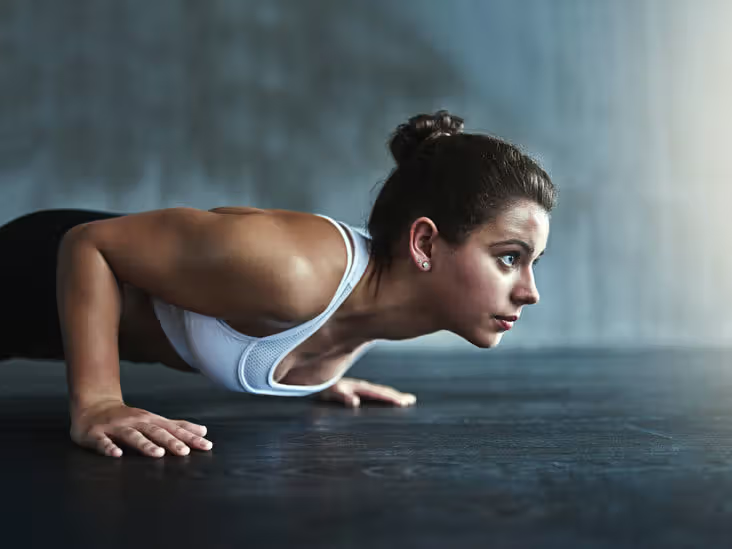
Plank Protraction: Holding a high plank and focusing solely on pushing the space between the shoulder blades toward the ceiling.
-
Forearm Weight Shifts: In a dolphin pose or forearm plank, shifting weight forward and back to test the serratus anterior’s ability to maintain protraction.
-
Overhead Shrugs: Using light weights or a resistance band to practice elevation while the arms are in full flexion.
-
Scapular Pull-ups: While hanging from a bar, moving the body up and down using only the movement of the shoulder blades, keeping the arms straight.
The Long-Term Impact of Scapular Mastery
Beyond the ability to hold an impressive inversion, mastering scapular stability has profound implications for long-term athletic health. The shoulder is the most mobile joint in the human body, but that mobility comes at the cost of inherent instability. By training the scapular stabilizers, an athlete builds a “buffer” against common injuries such as labral tears, bursitis, and tendonitis.
Furthermore, the strength gained in these deep stabilizing muscles carries over into other movements, such as overhead pressing, swimming, and even daily posture. When the scapula is stable, the entire upper body functions as a cohesive unit rather than a collection of disconnected parts.
Frequently Asked Questions
How can I tell if my scapulae are winging during an inversion?
Winging occurs when the medial border of the scapula lifts away from the rib cage. You can often feel this as a lack of “connection” to your core or see it in a video recording as two prominent ridges on your back. It usually indicates a weak serratus anterior or a lack of neural engagement in that area.
Is it better to keep the shoulder blades retracted or protracted in a handstand?
For a standard handstand, protraction is generally preferred. Protraction allows for a more stable hollow-body position and engages the serratus anterior to push the floor away. Retraction (squeezing the blades together) tends to collapse the chest and can lead to an unstable, arched back.
Why do my wrists hurt during inversions if the issue is my shoulders?
The kinetic chain is interconnected. If your scapular stability is poor, your shoulders may lean forward past your wrists to compensate for the lack of strength. This increases the degree of wrist extension beyond what is comfortable, placing excessive pressure on the carpal bones and tendons.
Can tight chest muscles affect scapular stability?
Yes, significantly. Tight pectoralis minor muscles can pull the scapula into a forward tilt (anterior tilt). This makes it physically difficult to achieve the upward rotation and posterior tilt necessary for a safe overhead position, essentially “locking” the shoulder out of its optimal range.
How long does it take to build the necessary scapular strength for a handstand?
This varies by individual, but most people require 3 to 6 months of consistent, targeted scapular conditioning. The stabilizing muscles are smaller and often more neglected than the primary movers, so they require high-frequency, low-intensity training to build endurance.
Should I focus on my core or my shoulders first for inversions?
While both are vital, the shoulders are your foundation. A strong core cannot save an inversion if the base (the shoulders) is collapsing. Think of the shoulders as the foundation of a building; if the foundation is shaky, it does not matter how strong the walls are.
Does breathwork impact scapular stability?
Absolutely. The serratus anterior is an accessory muscle of respiration. If you hold your breath or breathe shallowly into the upper chest, you may create unnecessary tension in the neck and upper trapezius, which can interfere with the fluid movement and stabilization of the scapula. Deep, lateral rib cage breathing is ideal.
